


Sustainable anchoring and the boating business: round table at the Foro Marino
One Planet One Life
- Location: Foro Marino de Ibiza y Formentera
On 21 October 2026, Diego de la Viña, representing One Planet One Life and Essence Sailing, took part in the round table on sustainable anchoring at the 8th Foro Marino de Ibiza y Formentera. This was our approach.
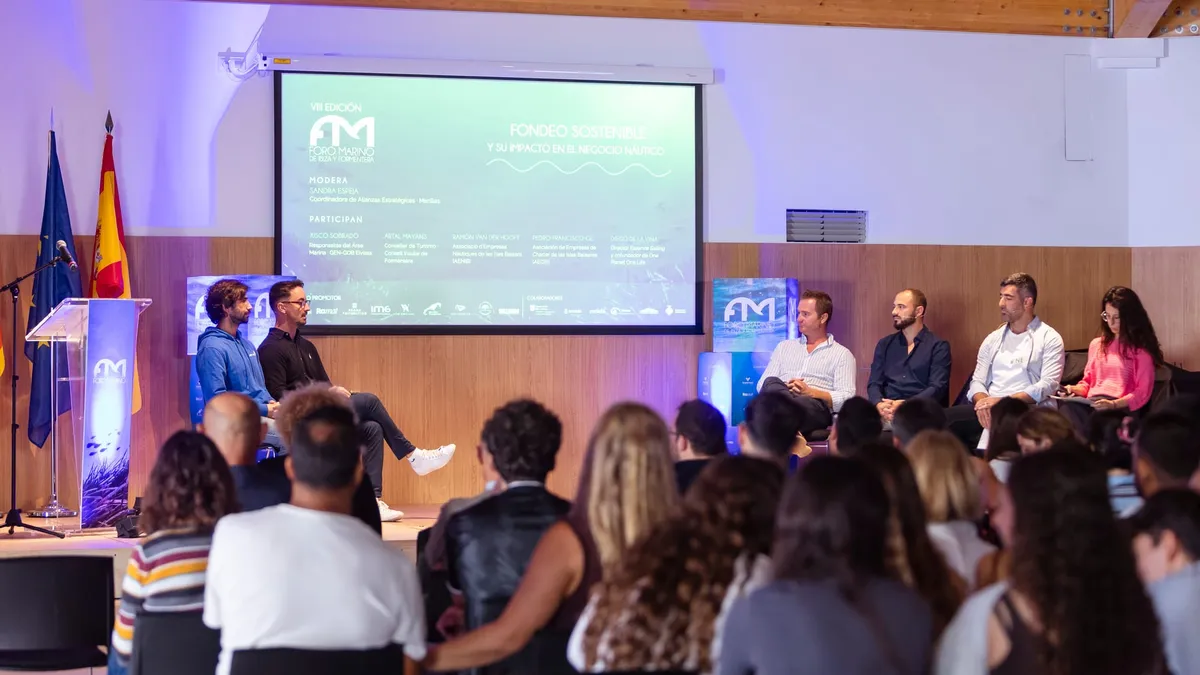
On 21 October 2026, Diego de la Viña, representing One Planet One Life and Essence Sailing, took part in the round table “Sustainable anchoring and its impact on the boating business”, at the 8th edition of the Foro Marino de Ibiza y Formentera.
Who took part
The round table was moderated by Sandra Espeja, Strategic Alliances Coordinator at Marilles. The participants were:
- Xisco Sobrado, head of the Marine Area at GEN-GOB Eivissa.
- Artal Mayans, Tourism councillor of the Consell Insular de Formentera.
- Ramón van der Hooft, representing the Associació d’Empreses Nàutiques de les Illes Balears (AENIB).
- Pedro Francisco Gil, representing the Asociación de Empresas de Charter de las Islas Baleares (AECIB).
- Diego de la Viña, director of Essence Sailing and co-founder of One Planet One Life.
Here is what we argued on behalf of One Planet One Life.
Understanding it from both sides
Our point was that anchoring has to be understood from both sides.
On one side, sustainability, which we come to through One Planet One Life and many years of defending sustainability in boating and wanting to look after the environment.
On the other, the boating side: Diego has been a captain for 14 years and loves sailing. With the knowledge gained, we think that if we do things well —administrations as much as users, NGOs and businesses— the impact can be much smaller than it is.
It’s hard to talk about completely sustainable boating with no waste at all. But inter-island sailing, apart from fuel consumption —there we can’t get involved—, can be a much more sustainable practice.
If nothing is legislated, nothing changes
We argued that when we want to protect something, we need to legislate. If nothing is legislated, things don’t change: the goodwill of people and companies can’t be a requirement for anything to change. It’s already been shown that human beings don’t work that way.
And once something is legislated, it isn’t enough to say “there’s already a rule protecting this; if you don’t comply, you should have known”. The responsibility of the administration, which is the one with the means, is to make sure that rule reaches everyone.
We gave an example from business: if a company wants to reach its customers, it makes it its job to reach its customers. It can’t say “I ran an ad, it didn’t reach them, no big deal”: if it doesn’t reach them, it doesn’t make money and goes under.
If that concept —if I don’t reach this many people, I go under— existed in the administration, a lot of what we do would reach many more people, because the goal would be to really get there, not just to do it and have it land on whoever it happens to land on.
On this, Artal Mayans, Tourism councillor of the Consell de Formentera, told us that the administration is overstretched, that it covers too many things and can’t keep up. That’s why we think that, in these cases, public-private collaboration with NGOs would be a good thing.
Don’t privatise the coast without justification
We also argued that the coast shouldn’t be privatised without justification.
Where there is a spot people want to anchor in and can’t because of posidonia, then yes: sustainable buoys, eco-friendly buoys.
But where there’s sand, nobody can say they are going to put in buoys for the sake of protection, because if it’s sand, anchoring doesn’t destroy it. That’s where not privatising for the sake of it comes in.
Inform people at the port and at the fuel dock
One of our proposals was to take advantage of the fact that almost every boat goes through a port and a fuel dock: to use those two points to hand over the information that has to be handed over.
When a boat is given the information, it’s recorded as delivered and taking it is mandatory; that way, next time we already know that boat is aware of it. If it’s doing things wrong, there’s no more “oh, I didn’t know”.
And we believe that whoever already knows something is wrong and does it anyway is who should be penalised, and with a penalty that goes in crescendo: the first one lighter, a wake-up call —“hey, we’re here, consider this a warning”—; the second, quite a bit more; the third, more again. Let it keep going up.
More photos from the day
Will you join the next one?
We need hands at every clean-up. No experience needed.